
Parts of a Plant Diagram
Every part of a flowering plant has a job: roots drink, stems carry, leaves make food and flowers make seeds. This interactive diagram labels all the main parts of a plant and its flower. Click a part to learn what it does, switch off the labels to test yourself, try the quiz, and print a labelled or blank diagram for class or homework.
- Free to use
- No sign-up
- Runs in your browser
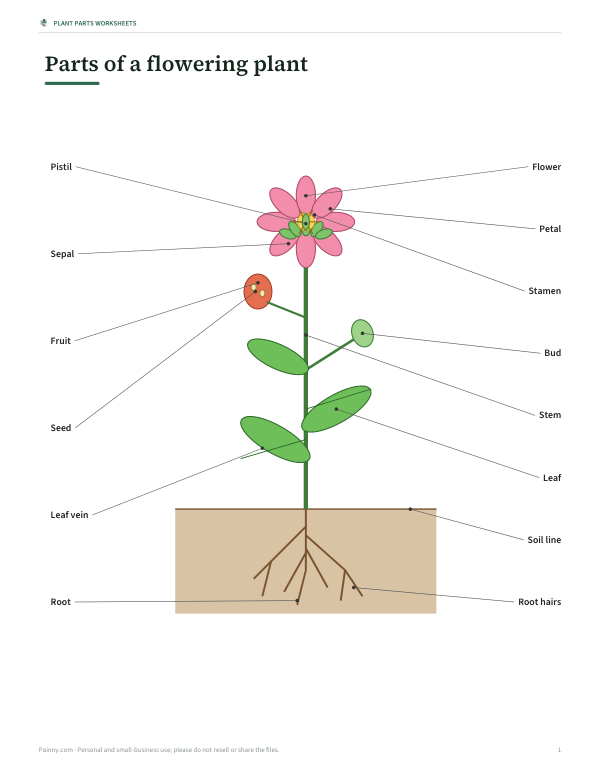
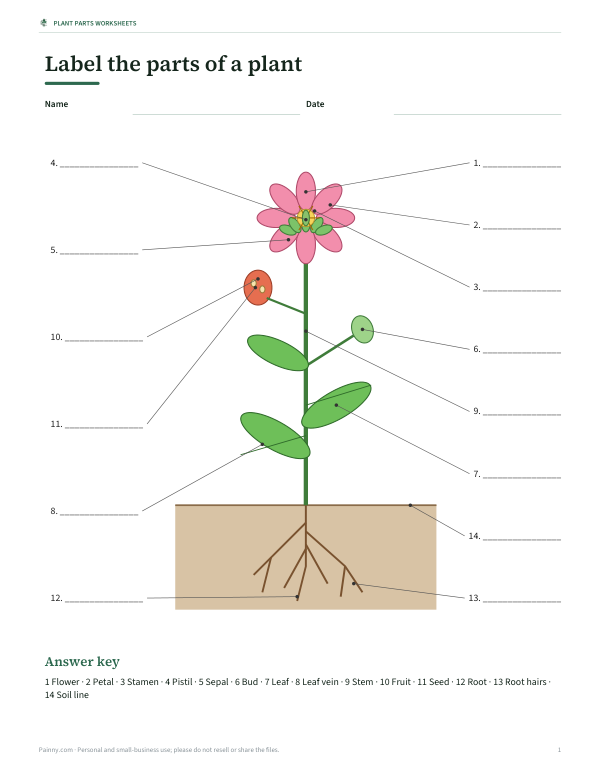
Parts of a plant — interactive diagram
Plant Parts Worksheets
Labelled and blank plant diagrams, a flower parts sheet, a plant life cycle worksheet and a “which part do we eat?” sorting activity, with answer keys.
- Labelled diagram (PDF)
- Blank diagram (PDF)
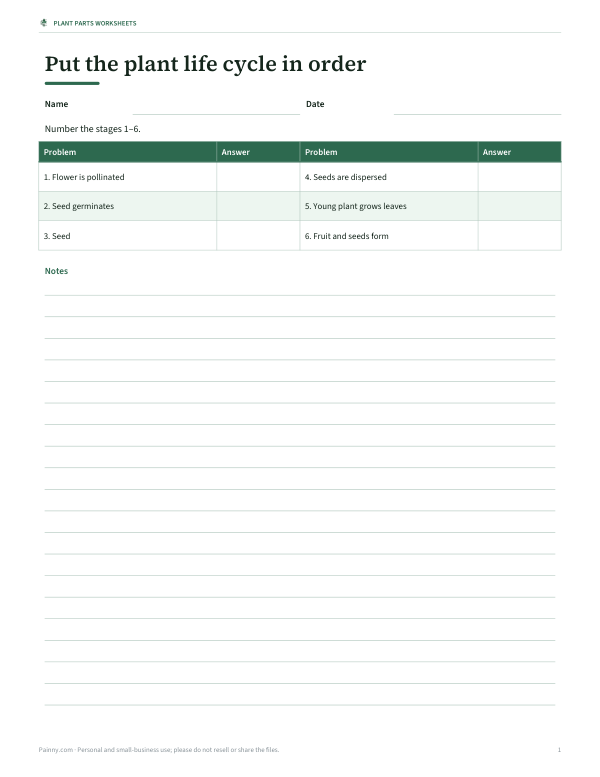
- Life cycle worksheet (PDF, DOCX)
- Which part do we eat? (PDF, DOCX)
Formats: PDF, DOCX. Instant download after payment (link valid 72 hours, up to 5 downloads). AI-assisted: the templates were drafted with AI help and reviewed and laid out before publishing.
$5.00 USD, one-time 4 files · about $1.25 each
- Instant download
- 7-day refund
- Secure checkout by Stripe
7-day money-back guarantee. Full refund within 7 days of purchase, even after you download.
Free sample: Plant Life Cycle (PDF, 51 KB)
Full refund within 7 days — see the refund policy and license.
Free printables
Single sheets you can print right now, no sign-up. The full pack adds every sheet in one download plus the editable files.
 Which Part Do We Eat Printable
The main parts of a plant and what they do
| Part | Job |
|---|---|
| Flower | The reproductive part of the plant; attracts pollinators and produces seeds. |
| Petal | Colourful parts of the flower that attract insects and birds. |
| Stamen | The male part of the flower: a filament topped by an anther that makes pollen. |
| Pistil | The female part: stigma (catches pollen), style and ovary (holds ovules that become seeds). |
| Sepal | Small leaf-like parts that protect the flower bud before it opens. |
| Bud | An undeveloped flower or shoot. |
| Leaf | Makes food for the plant by photosynthesis, using sunlight, water and carbon dioxide. |
| Leaf vein | Carries water into the leaf and sugars out; also supports the leaf. |
| Stem | Holds the plant up and transports water and food between roots and leaves. |
| Fruit | Develops from the ovary after pollination and protects the seeds. |
| Seed | Contains a baby plant (embryo) and stored food. |
| Root | Anchors the plant and absorbs water and minerals from the soil. |
| Root hairs | Tiny hairs that greatly increase the root’s surface area for absorbing water. |
How the parts work together
Roots take in water and minerals from the soil; the stem carries them up to the leaves through tiny tubes (xylem). Leaves use sunlight, water and carbon dioxide from the air to make sugar by photosynthesis, releasing oxygen. The sugar travels around the plant in other tubes (phloem) to where it is needed for growth, or is stored in roots, fruits and seeds. Flowers produce seeds so the plant can reproduce, and fruits help spread those seeds.
Parts of a flower
| Part | Male or female | Job |
|---|---|---|
| Petals | — | Attract pollinators with colour and scent |
| Sepals | — | Protect the bud |
| Anther | Male (stamen) | Makes pollen |
| Filament | Male (stamen) | Holds up the anther |
| Stigma | Female (pistil / carpel) | Sticky tip that catches pollen |
| Style | Female | Tube from stigma to ovary |
| Ovary | Female | Contains ovules, which become seeds; the ovary becomes the fruit |
| Nectary | — | Makes nectar to reward pollinators |
From flower to seed
- Pollination: pollen moves from an anther to a stigma — carried by insects, birds, wind or water.
- Fertilisation: a pollen tube grows down the style to an ovule.
- Seed formation: the fertilised ovule develops into a seed.
- Fruit formation: the ovary swells into a fruit around the seeds.
- Dispersal: seeds are spread by wind, animals, water or by the fruit bursting open.
- Germination: with water, warmth and air, a seed sprouts into a new plant.
Worked example: a sunflower
A sunflower shows every part clearly. Its thick roots anchor a tall stem that turns the young flower head towards the sun. Broad leaves make food all summer. The big “flower” is actually hundreds of tiny flowers: the petal-like rays around the edge attract bees, and the small disc flowers in the centre each make one seed — the sunflower seeds we eat. After pollination the head droops as the seeds ripen and dry.
Types of roots and stems
| Type | Example | Notes |
|---|---|---|
| Taproot | Carrot, dandelion | One thick main root that stores food |
| Fibrous roots | Grass, wheat | Many thin roots that hold soil together |
| Upright stem | Sunflower | Holds leaves and flowers up to the light |
| Climbing stem | Beans, ivy | Twines or uses tendrils to climb |
| Underground stem (tuber) | Potato | Stores food; the “eyes” are buds |
| Runner | Strawberry | Grows along the ground and makes new plants |
What plants need to grow
- Light — for photosynthesis in the leaves.
- Water — taken up by roots; also keeps the plant firm.
- Air — carbon dioxide for photosynthesis and oxygen for the roots.
- Nutrients — minerals such as nitrogen from the soil.
- Warmth — most plants grow best within a certain temperature range.
- Space — room for roots and leaves to spread.
Activities for children
- Pull up a weed and look at the roots and root hairs with a magnifier.
- Put a white carnation or celery stalk in coloured water to watch the stem transport water.
- Take a flower apart and stick each part on the worksheet.
- Grow a bean in a clear jar to see roots and shoots appear.
- Match foods to plant parts: carrot (root), celery (stem), lettuce (leaf), broccoli (flower buds), apple (fruit), peas (seeds).
Using the interactive diagram
- Labelled mode shows every part; click a part to read its job.
- Numbered mode hides the names — say or write them, then check.
- Quiz mode describes a part and asks you to pick its name.
- Print either version as a worksheet.
Printable plant pack
The optional pack includes labelled and blank plant diagrams, a flower parts diagram, a plant life cycle worksheet and a “which part do we eat?” sorting activity, all with answer keys. The diagram above is free.
AI-assisted content
This page was drafted with AI assistance and reviewed before publishing. The diagram is simplified and not to scale.
Frequently asked questions
What are the main parts of a plant?
Roots, stem, leaves and flowers — with fruits and seeds forming from the flower.
What does the stem do?
It supports the plant and carries water, minerals and food between roots and leaves.
What is the female part of a flower?
The pistil (carpel): stigma, style and ovary.
What is the male part of a flower?
The stamen: anther and filament.
What do root hairs do?
They increase the surface area for absorbing water and minerals.
Can I print a blank plant diagram?
Yes, choose Numbered mode and print.
Where does photosynthesis happen?
Mainly in the leaves, in green chloroplasts that capture light energy.
Do all plants have flowers?
No — mosses, ferns and conifers reproduce without flowers, using spores or cones.
Why are leaves green?
They contain chlorophyll, which absorbs red and blue light and reflects green.